Ever wondered why some filter presses work like a charm while others struggle to keep up with production demands?
Here’s the deal: it all comes down to getting the filtration area calculation right. And in this guide, as a professional filter press manufacturer, I’m going to show you exactly how to calculate filtration area of filter press systems using methods that actually work in the real world.
Let me break it down for you step-by-step.
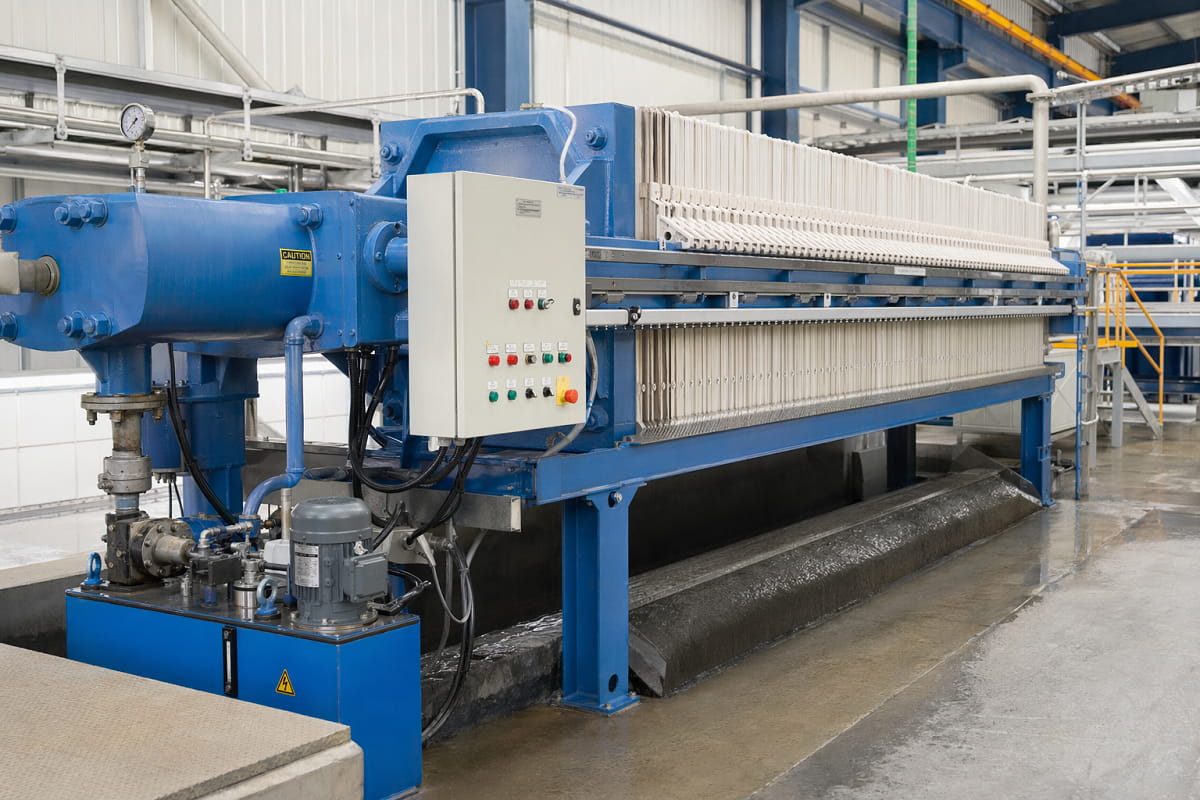
What Is Filtration Area and Why Does It Matter?
Think of filtration area as the total surface space where the magic happens – where liquid passes through the filter media while solids stay behind.
Get this wrong, and you’re looking at:
- Production bottlenecks
- Incomplete dewatering
- Wasted energy
- Premature equipment failure
But here’s the thing:
When you nail the filtration area calculation, your filter press runs like a well-oiled machine. You get optimal throughput, consistent cake dryness, and minimal cycle times.
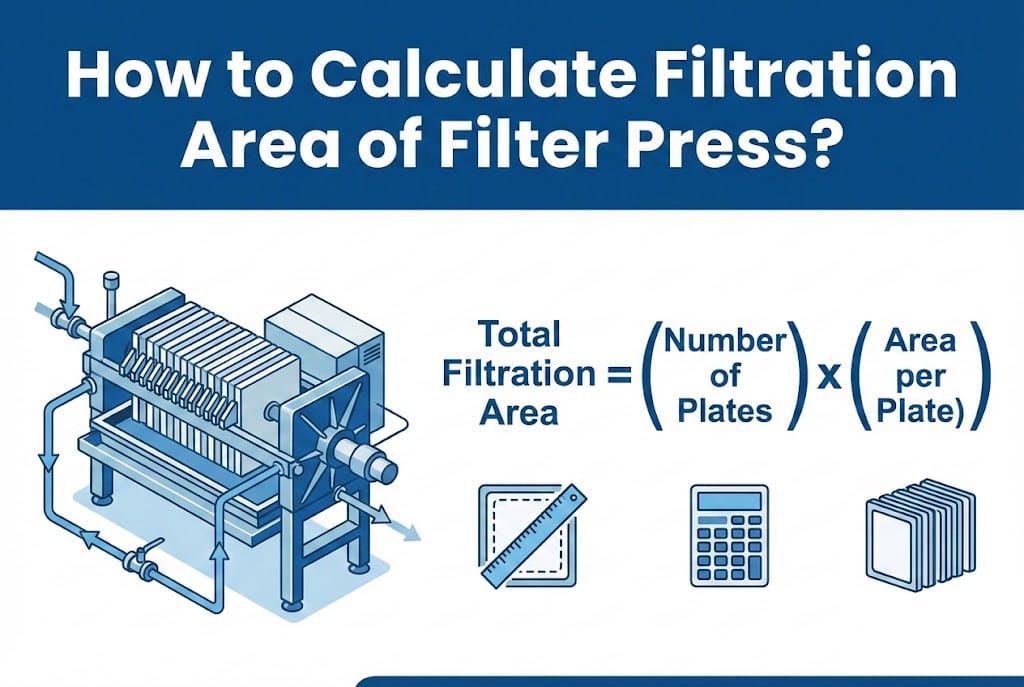
Basic Formula of Filter Press Area Calculation
Let’s start with the fundamental equation for calculating filtration area:
A = V × C / (ρ × t × η)
Where:
- A = Required filtration area (m² or ft²)
- V = Volume of slurry to process (m³ or gallons)
- C = Solids concentration (%)
- ρ = Cake density (kg/m³ or lbs/ft³)
- t = Total cycle time (hours)
- η = Efficiency factor (typically 0.7-0.9)
Sound complicated? Don’t worry. I’ll walk you through real examples in a minute.
How to Calculate Filtration Area of Filter Press?
Method #1: The Process Requirements Approach
This is my go-to method when sizing a new filter press from scratch.
Step 1: Gather Your Process Data
First, you need these key numbers:
- Daily slurry volume
- Solids concentration
- Operating hours per day
- Desired cycle time
For example, let’s say you’re processing wastewater with:
- 1,800 gallons per day
- 8% solids by weight
- 8 hours of operation
- 3 cycles per day target
Step 2: Calculate Volume Per Cycle
Simple math here:
1,800 gallons ÷ 3 cycles = 600 gallons per cycle
Step 3: Determine Required Press Volume
Using our formula and assuming:
- Cake density: 75 lbs/ft³
- Efficiency factor: 0.85
You’d need approximately 24 cubic feet of press volume.
Pro Tip: Always add 10-15% safety factor to your calculations. Trust me, you’ll thank yourself later when feed conditions vary.
Method #2: The Physical Dimensions Approach
Already have a filter press? This method helps you calculate its actual filtration area.
Calculating Single Plate Area
For rectangular plates:
Area = Length × Width × 2 (both sides filter)
For circular plates:
Area = π × (Diameter/2)² × 2
Total Filtration Area
Here’s where it gets interesting:
Total Area = Single Plate Area × Number of Filter Chambers
Remember: The number of chambers equals the number of plates minus one.
Let me give you a real example:
I recently worked with a client who had a 16″ × 16″ filter press with 10 plates.
- Single plate area: 16″ × 16″ = 256 sq inches = 1.78 sq ft
- Both sides: 1.78 × 2 = 3.56 sq ft per plate
- Total chambers: 10 – 1 = 9 chambers
- Total filtration area: 3.56 × 9 = 32 sq ft
Critical Factors That Impact Your Calculations
1. Particle Size Distribution
Fine particles = slower filtration = more area needed
I’ve seen operations undersize their equipment because they didn’t account for seasonal variations in particle size. Don’t make that mistake.
2. Temperature Effects
Higher temperatures typically improve filtration rates by 2-3% per 10°F increase. But they also affect material expansion and seal performance.
3. Chemical Conditioning
Using flocculants? They can reduce your required filtration area by 20-30%. But you need to factor in mixing time and chemical costs.
4. Cake Thickness Targets
Thicker cakes mean:
- Longer cycle times
- Higher cake dryness
- More chamber volume needed
The sweet spot? Usually 25-32mm for most applications.
Real-World Sizing Example
Let me walk you through an actual calculation I did for a mineral processing plant in January 2026.
The Challenge:
- Process 10 m³/hour of mineral slurry
- 30% solids content
- Target 70% cake dryness
- 16 hours operation per day
Step 1: Daily Volume
10 m³/hour × 16 hours = 160 m³/day
Step 2: Dry Solids Calculation
160 m³ × 30% × 1.2 (specific gravity) = 57.6 tons of dry solids
Step 3: Cake Volume
At 70% dryness and 1.8 tons/m³ cake density:
57.6 tons ÷ (0.7 × 1.8) = 45.7 m³ of cake per day
Step 4: Required Filtration Area
Assuming 4 cycles per day and using industry-standard filtration rates:
A = 45.7 ÷ 4 × 2.5 = 28.6 m²
The Result: We specified a 1000mm filter press with 30 chambers, providing 32 m² of filtration area – perfect with a safety margin.
Common Sizing Mistakes to Avoid
I’ve seen these errors cost companies thousands:
Mistake #1: Ignoring Feed Variability
Your calculations might be perfect for average conditions, but what happens during upset conditions? Always design for the worst case.
Mistake #2: Overlooking Auxiliary Operations
Cake washing adds 15-30 minutes per cycle. Membrane squeezing? Another 10-20 minutes. Factor these in or face bottlenecks.
Mistake #3: Forgetting About Cloth Blinding
Over time, filter cloth pores get clogged. Your effective filtration area can drop by 20-30%. Plan for it with oversizing or regular cloth replacement.
Advanced Optimization Techniques
Once you’ve got the basics down, here’s how to fine-tune your calculations:
Use Pilot Testing Data
Nothing beats real-world testing. Run trials with your actual feed material to get accurate:
- Specific cake resistance
- Compressibility index
- Optimal pressure curves
Consider Variable Pressure Operation
Starting at low pressure (3-4 bar) and ramping up to 15-16 bar can improve both filtration rate and cake dryness.
Factor in Cake Discharge Time
Automated plate shifters save 50-70% on discharge time compared to manual operation. This directly impacts your cycle time calculations.
Quick Reference Chart
Here’s a handy reference I’ve developed over the years:
| Application | Typical Filtration Rate | Cake Thickness | Cycle Time |
|---|---|---|---|
| Municipal Wastewater | 10-25 kg/m²/hr | 25-30mm | 2-4 hours |
| Mining Concentrate | 50-150 kg/m²/hr | 30-40mm | 20-45 min |
| Chemical Process | 30-80 kg/m²/hr | 20-32mm | 1-2 hours |
| Food & Beverage | 15-40 kg/m²/hr | 15-25mm | 1-3 hours |
Software Tools That Make Life Easier
While manual calculations work fine, these tools can speed things up:
- Manufacturer Sizing Software – Most reputable manufacturers offer free sizing tools
- Process Simulation Packages – For complex multi-stage operations
- Spreadsheet Templates – Create your own or download industry-standard versions
The bottom line? Start with manual calculations to understand the principles, then use tools for efficiency.
Putting It All Together
Calculating filter press filtration area doesn’t have to be rocket science. Follow these key steps:
- Gather accurate process data – garbage in, garbage out
- Use the appropriate calculation method – process requirements for new systems, physical dimensions for existing
- Apply reasonable safety factors – 10-15% minimum
- Consider all operational factors – temperature, chemicals, maintenance
- Validate with pilot testing when possible
Remember: The most expensive filter press is one that doesn’t meet your needs. Take the time to calculate properly upfront.
Next Steps
Now that you understand how to calculate filtration area of filter press systems, here’s what to do:
- Audit your existing equipment to verify adequate sizing
- Run pilot tests with seasonal feed variations
- Develop standard calculations for your specific applications
- Train operators on the impact of process variables
Got questions about specific applications? Working with unusual feed materials?
The key is starting with solid calculations and adjusting based on real-world performance. Because at the end of the day, proper filter press sizing is what separates smooth operations from constant headaches.
Master these calculations, and you’ll design systems that run efficiently for years. Skip them, and you’ll be explaining to management why production can’t meet targets.
The choice is yours.